
Here is something that might surprise you about the sport of athletics. The difference between a world record and a failed attempt can come down to something as small as a few centimeters on a runway or a tiny smear of plasticine. The rules that govern events like long jump and triple jump have been developed over more than a century of competition and they are designed to ensure fairness and safety and consistency from the local school meet all the way up to the Olympic Games. Whether you are a athlete trying to understand why your jump did not count or a fan watching on television trying to figure out what just happened or a coach preparing your team for competition the rules matter. They shape everything about how these events are conducted. This article will walk you through the essential rules for both long jump and triple jump covering everything from the runway to the sandpit and explaining the differences between these two spectacular events.
The Basic Objective of Both Events
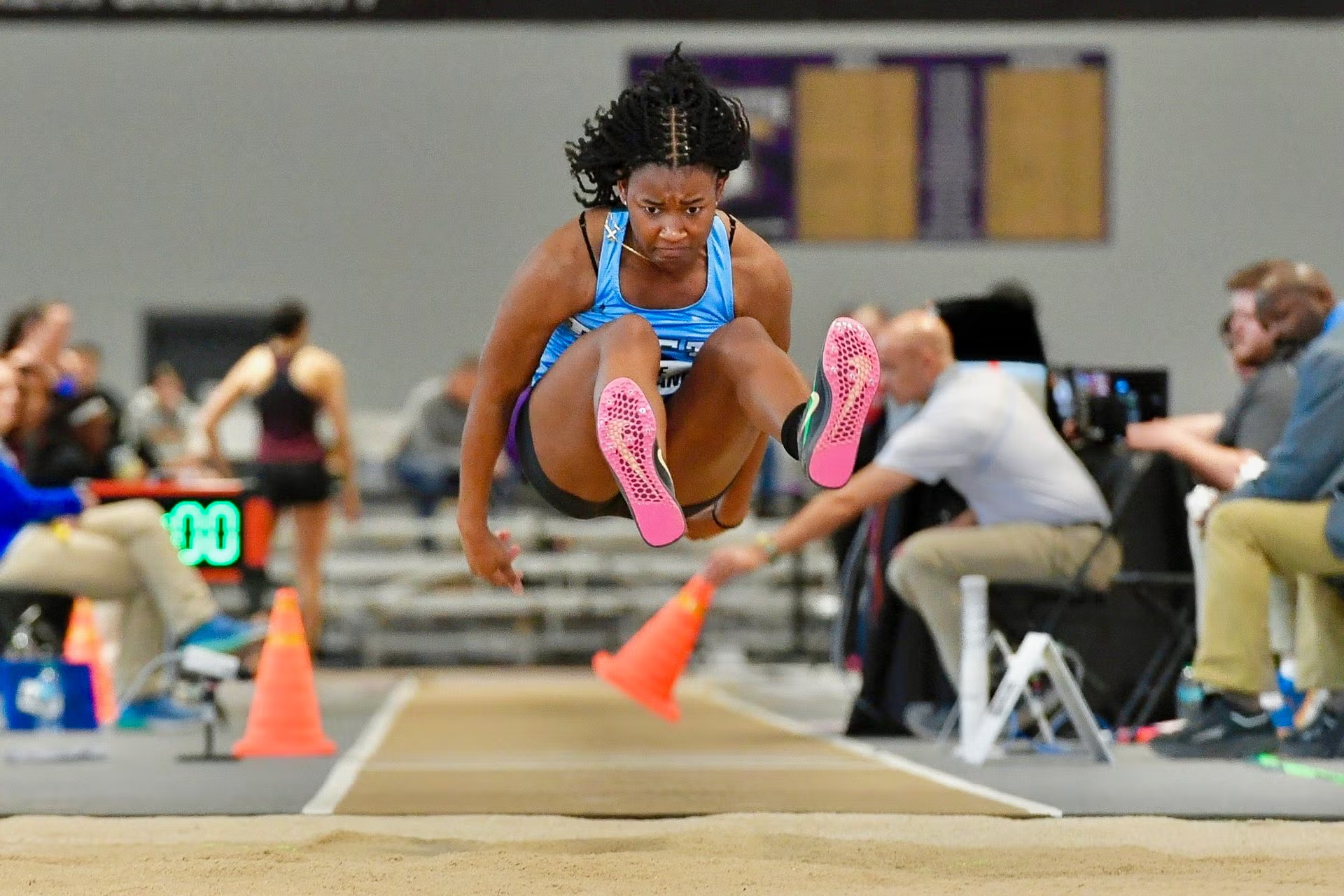
Before we dive into the specific rules let us be clear about what athletes are trying to accomplish. In both long jump and triple jump the goal is the same. Travel as far as possible from a takeoff point into a sand filled landing pit . The athlete sprints down a runway builds up as much speed as they can control and then launches themselves into the air. The distance is measured from the front edge of the takeoff board to the closest mark made in the sand by any part of the athlete’s body. That last part is crucial. If an athlete lands and then falls backward and their hand touches the sand closer to the board than their feet that is where the measurement is taken from. The distance is measured in a straight line perpendicular to the takeoff board or the takeoff line.
The fundamental difference between the two events is what happens between the takeoff and the landing. Long jump is one single explosive leap. Triple jump as the name suggests involves three distinct phases. The athlete hops lands on the same foot that took off then steps landing on the opposite foot and then jumps landing in the pit with both feet . This sequence requires a completely different technique and the rules reflect that difference.
The Runway and Takeoff Board
The runway is where every jump begins and the rules governing it are precise. According to the USA Track and Field Rule Book the minimum length of the runway is forty meters or about one hundred thirty one feet . This gives athletes enough distance to accelerate to maximum controllable speed. There is no maximum length specified in most rules so some competition venues have longer runways than others.
At the end of the runway sits the takeoff board. This is a rectangular piece of white wood or other rigid material that is sunk into the track so that it is level with the surface. The board is eighteen to twenty two centimeters long which is approximately seven to about eight point six inches . For long jump the board is twenty centimeters wide typically. For triple jump the same board is used but the distances from the board to the pit are often adjusted based on the athlete’s ability level and the competition level.
Behind the takeoff board there is usually a strip of plasticine or modeling clay. This is one of the most important pieces of equipment in the event. When an athlete takes off their foot leaves an imprint in the plasticine if any part of their foot extends beyond the front edge of the board. That imprint signals a foul and the jump does not count regardless of how far the athlete traveled. The plasticine does not lie. It provides objective evidence that officials can use to make accurate calls.
The Foul Rule That Ends Great Jumps
There is nothing more heartbreaking in these events than watching an athlete soar through the air landing what looks like a record breaking distance only to see the red flag go up. The most common reason for a foul is overstepping the takeoff board. If any part of the takeoff foot lands beyond the front edge of the board the jump is invalid . This rule applies equally to long jump and triple jump.
But there are other ways to foul as well. In long jump athletes must take off from one foot. If they take off from two feet it is a foul. In triple jump the sequence is strictly regulated. The athlete must execute the hop step and jump in that order. During the hop they must land on the same foot that they used for takeoff. During the step they must land on the opposite foot. If they lose this sequence if they land incorrectly or skip a phase the jump does not count .
Another rule that catches athletes sometimes is leaving the landing pit incorrectly. After landing athletes are supposed to exit the pit by moving forward beyond the mark they made. If they walk back through the pit and disturb the sand behind their landing mark it can make accurate measurement difficult. In some competitions this can lead to a warning or even a failed attempt if done intentionally.
Measurement Procedures
Measuring a jump sounds simple but there are specific rules about how it must be done. Officials measure from the front edge of the takeoff board at the point of takeoff to the closest mark made in the sand by any part of the athlete’s body . That means if an athlete lands and then puts a hand behind them to break their fall the measurement is taken from that hand not from their feet. This is why you see long jumpers trained to fall forward or to the side to avoid leaving a mark behind them.
The measurement is taken perpendicular to the takeoff line or its extension. Officials use a steel tape measure and pull it taut for accuracy. In major competitions electronic measurement systems are now used but the principle is the same. The distance is recorded to the nearest one quarter centimeter in most competitions or to the nearest centimeter in some youth competitions.
Number of Attempts and Competition Format
At most major competitions including the Olympics and World Championships each athlete gets six jump attempts . However there is a qualification round first. In large fields athletes compete in qualifying groups and those who achieve a predetermined standard or finish in the top positions advance to the final. The qualification marks vary by competition level. For example at the 2017 World Championships the entry standard for men’s long jump was set at eight point one five meters while the women’s standard was six point seven five meters . For men’s triple jump the standard was sixteen point eight zero meters and for women it was fourteen point one zero meters .
In the final all athletes typically get three jumps. Then the top eight athletes usually receive three additional jumps for a total of six. This format allows athletes who have a slow start to still have a chance to win. Some competitions use a different format but the three plus three model is most common.
In the case of a tie the winner is determined by the second best jump of the tied athletes . If they are still tied it goes to the third best and so on. If they are tied on every jump then it is declared a tie and both receive the same placing.
Safety Rules and Facility Requirements
Safety is paramount in these events and the rules reflect that. The landing pits must be filled with sand to a depth of at least thirty centimeters or about twelve inches according to IAAF rules . The sand must be kept loose and free of clumps and foreign objects. Officials are required to rake the pit after every jump to ensure a consistent landing surface.
The takeoff area must be firm and flat . Boards must be level and firmly attached. The runway surface must provide safe footing and traction and must be free of water puddles. For safety reasons the area around the pit and runway must be kept clear of spectators and other participants.
There are specific distance requirements as well. For long jump there must be a distance of one meter to three meters between the takeoff board and the front edge of the pit . This distance varies based on the age and ability level of the athletes. For triple jump the takeoff areas must be at an appropriate distance from the pit to allow for a safe landing on the second phase which is the step.
Equipment safety is also covered in the rules. Rakes and shovels used for maintaining the pit must be kept away from the runway and pit area when not in use . When raking is in progress the person raking must hold the rake with prongs down and must remove the rake before the next competitor begins their approach.
Footwear Rules
Athletes have specific requirements for their footwear. Spikes are permitted up to nine millimeters in length on rubberized asphalt grass or gravel surfaces . The exact allowable spike length can vary by competition level and surface type. No track shoes without spikes are permitted in most competitions and bare feet or socks without shoes are not allowed for safety reasons.
The spikes themselves must be of a type that does not damage the runway excessively. In major competitions officials may inspect footwear before competition begins to ensure compliance.
The Important Difference Between Long Jump and Triple Jump Rules
While the two events share many rules there are crucial differences. In long jump the athlete simply sprints and takes off from the board landing in the pit. In triple jump the athlete must complete three distinct phases. The hop is the first phase where the athlete takes off from one foot and lands on the same foot. The step is the second phase where the athlete lands on the opposite foot. The jump is the final phase where the athlete lands in the pit with both feet .
The foot sequence is strictly enforced. If an athlete lands incorrectly at any phase the jump is invalid. This is why triple jumpers spend years perfecting their rhythm and technique. The forces involved are enormous. Research has shown that hop landings can require the jumper to absorb between fifteen and twenty times their bodyweight . The leg would actually break if the force was not returned through the muscles and tendons in milliseconds. The rules ensure that athletes are attempting this feat in a standardized way.
Another difference is the distance from the board to the pit. In triple jump this distance is often adjusted based on the athlete’s ability. Younger athletes jump from closer to the pit . Some experts argue that these distances are still too far for developing athletes and that more graduated distances would be beneficial for safety and skill development.
Competition Schedule Rules
The timing of events is also governed by rules. According to IAAF guidelines for major championships there are specific principles about rest days between qualifying and finals. For horizontal jumps the rules differ. Long jump typically has no rest day between qualifying and final while triple jump includes one rest day between qualifying and final . This recognizes the greater physical demands of the triple jump with its three phases and higher impact forces.
The overall competition schedule aims to allow for traditional doubling where athletes compete in both long jump and triple jump. The IAAF principles note that whenever practicable the possibility for traditional doubling should be allowed which means scheduling events with enough separation that athletes can compete in both .
Recent Rule Changes and Innovations
Athletics rules are not static. They evolve over time to improve fairness and safety and spectator experience. One significant recent change relates to who decides where the takeoff boards are placed. A new rule added for 2026 permits the Games Committee to determine takeoff board placement in horizontal jumps . Previously the rules did not assign this responsibility clearly. The change aligns with the existing role of the games committee in setting starting heights for high jump and pole vault. Athletes may still change which approved takeoff board to use during competition.
This change ensures consistency fairness and appropriate oversight in meet management. It might seem like a small administrative detail but it matters for how competitions are run.
Another innovation that has been tested experimentally is a longer takeoff zone. World Athletics introduced an experimental change at the ISTAF indoor meet where the takeoff zone was forty centimeters long instead of the traditional twenty centimeter board . This new zone uses cameras to measure jumps from the athlete’s actual takeoff point rather than from the edge of the board. The goal is to reduce fouls and enhance the spectator experience since more jumps count and athletes can be more aggressive.
Two time world champion Malaika Mihambo won under this new rule with a jump of six point eight seven meters . Reactions from athletes have been mixed but the change has received praise for making competitions more thrilling. Traditional rankings still measure from the board’s edge for record purposes but the experimental format shows that the sport is willing to innovate.
Rules for Different Competition Levels
It is important to understand that rules can vary slightly depending on the competition level. The National Federation of State High School Associations in the United States publishes rules for high school competition that sometimes differ from international rules. For example recent NFHS rule changes for 2026 include incorporating metric measurements alongside imperial to promote clarity and consistency in meet management . Standard metric progressions are typically in five centimeter increments with fifteen centimeters aligning closely to the traditional six inches. This change simplifies implementation and aligns with common metric practices.
For younger athletes the run up length is often adjusted. Up to about fourteen years of age the number of run up strides is typically around the age of the athlete plus or minus a couple of strides . A twelve year old would run twelve to fourteen strides in their approach. This recognizes that younger athletes cannot control the same speed and distance as elite competitors.
The Role of Officials
Officials are the guardians of the rules and they have specific responsibilities. In the horizontal jumps there is usually a minimum of two officials at the takeoff board. One watches the foot placement to determine if a foul occurred and the other watches the plasticine for evidence. Other officials manage the raking of the pit measure the jumps and record the distances.
When an official raises the white flag it means the jump is valid. The red flag indicates a foul. Athletes learn to watch for these signals immediately after landing. In major competitions there is also a referee who oversees the entire event and makes final decisions on any disputes.
Officials must be trained in proper procedures. For student rakers for example there are specific rules to follow. Remove the rake before the next competitor begins their approach. Hold the rake with prongs pointing downward. Begin raking only after the competitor has exited the pit. Rake sand toward the middle rather than out to the sides .
The Spirit of the Rules
Beyond the technical details there is a spirit to these rules that is worth understanding. The rules exist to ensure that victory goes to the athlete who can truly jump the farthest under fair and consistent conditions. They protect athletes from unsafe conditions. They provide a standardized framework so that performances from different competitions and different eras can be compared.
The rules also preserve the integrity of the events. The triple jump sequence of hop step and jump is what makes that event unique. If athletes could use any sequence it would be a different event entirely. The takeoff board creates a clear measurable point of reference. The plasticine provides objective evidence of fouls. Every rule has a purpose even if that purpose is not immediately obvious.
Common Misunderstandings
Let me clear up a few things that often confuse people. First the distance jumped is not measured from where the athlete’s feet land. It is measured from the closest mark in the sand. That could be a hand or a heel or even a hip if the athlete lands awkwardly. This is why technique matters so much in the landing phase.
Second the takeoff board is not the only place where fouls can occur. In triple jump athletes can foul by not completing the correct foot sequence. They can foul by dragging a leg during a phase. They can foul by stepping outside the runway markings during their approach. Any of these results in a failed attempt.
Third athletes do not automatically get six jumps in every competition. In large qualifying rounds they may get only three or four attempts depending on the format. In some developmental meets the number of attempts may be reduced to keep the competition moving.
Fourth the plasticine is not there to punish athletes. It is there to provide clear evidence. Before plasticine officials had to judge by eye whether a toe crossed the line. Now there is no dispute. If there is an imprint in the plasticine it is a foul. If there is no imprint the jump is good.
Putting It All Together
So what does this mean for someone watching a competition or preparing to compete? For spectators understanding the rules makes the event more exciting. When you see an athlete soar through the air you can appreciate not just the distance but the technical difficulty of hitting the board perfectly while at full speed. When you see a foul you understand what went wrong.
For athletes the rules define what good technique looks like. Long jumpers practice their run up thousands of times to hit the board consistently. Triple jumpers drill the hop step and jump sequence until it becomes automatic. They learn to fall forward in the pit to avoid leaving a mark behind. They study the rules to understand exactly what is allowed and what is not.
For coaches the rules shape how they teach. They must ensure their athletes understand the foot sequence for triple jump. They must teach run up accuracy and proper landing technique. They must know the safety rules and ensure their facilities meet standards.
A Final Word on Fairness and Excellence
The rules of long jump and triple jump have been refined over more than a century of competition. They represent the collective wisdom of athletes and coaches and officials who have dedicated their lives to these events. The rules are designed to do one thing above all else. Ensure that the athlete who performs best on the day is the one who wins.
Every detail from the depth of the sand to the placement of the takeoff board to the measurement procedures exists to create a fair competition. When an athlete sets a world record we can trust that it was achieved under conditions that were the same for everyone. When an athlete wins a gold medal we know they earned it within a framework that rewards genuine excellence.
The next time you watch a long jump or triple jump competition pay attention to the officials and the equipment and the procedures. Notice how athletes adjust their run ups and how they react to the white or red flag. Appreciate the precision and skill required to execute these events within the rules. And remember that every great jump is not just a feat of athleticism but also a successful navigation of the rules that define the sport.