
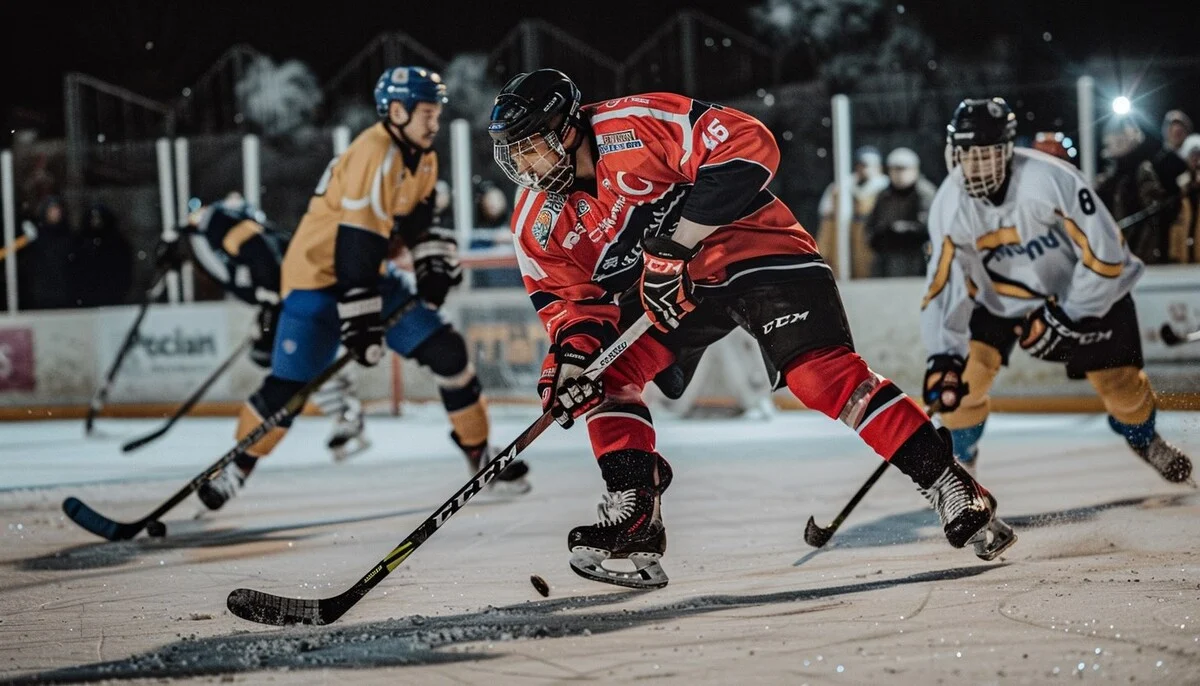
The Fundamental Objective of Hockey
At its simplest and most essential level, hockey is a game built around one straightforward objective: score more goals than the opposing team. Every rule, every strategy, every moment of play ultimately circles back to this basic premise. The team that places the puck into the opponent’s net more times during the allotted playing time emerges victorious. This fundamental simplicity is part of what makes hockey so accessible to new fans while still offering layers of complexity that reward deeper understanding. A goal in hockey is awarded when the puck completely crosses the goal line between the two goalposts and beneath the crossbar. This might sound simple enough, but the precision required matters enormously. The entire puck must cross the entire line. If any part of the puck remains on the goal line, even a millimeter, it does not count as a goal. This is why modern arenas are equipped with sophisticated overhead cameras and goal-line technology that allow officials to review close calls and ensure absolutely accurate calls. The margin between a goal and no goal can be impossibly thin, and technology ensures that the correct decision is made every time.
The last player on the attacking team to touch the puck before it enters the net receives credit for the goal. This holds true even if the puck barely touches them, a simple deflection off a skate or stick is enough to award credit to that player. Sometimes a shot misses the net entirely, bounces off the back boards, hits a defender’s skate, and trickles in. The credit still goes to the player who took the original shot, as they were the last attacker to touch it. This rule ensures that players are properly recognized for creating scoring chances, even when luck plays a role in the eventual outcome.
How a Legal Goal Is Scored
Players have developed an extraordinary arsenal of techniques for putting the puck in the net over the centuries that hockey has evolved. The wrist shot remains one of the most common and effective methods, combining accuracy with a relatively quick release. Players cup the puck in the curve of their blade and use a snapping motion of the wrists to propel it toward the net. The slap shot, made famous by hockey’s hardest shooters, involves winding up with the stick and slamming it into the ice just behind the puck, creating tremendous velocity. Deflections and tip-ins occur when a player redirects a teammate’s shot past the goaltender, often from in close. Rebound goals happen when the goalie makes an initial save but cannot control the rebound, allowing an attacking player to pounce on the loose puck and deposit it into the net before the goaltender can recover.
What matters in every case is that the puck crosses the line legally. Players may use their sticks, skates, or bodies to direct the puck, with one critical exception: they cannot intentionally use their hands or arms to propel the puck into the net. A puck deflecting off a skate is perfectly legal and happens frequently, especially in the traffic-filled areas around the crease. However, a deliberate kicking motion, where the player makes an obvious attempt to swing a skate and direct the puck, invalidates the goal. This distinction can sometimes be subtle, and officials are trained to differentiate between a puck that simply bounces off a skate and one that is actively kicked.
When Goals Are Disallowed
Not every puck that crosses the line counts as a goal, and understanding why goals get waved off is essential for following the game. Several situations nullify what would otherwise appear to be a perfectly good goal, and these rules exist to maintain fairness and safety.
High Stick Infraction stands as one of the most common reasons for disallowed goals. If a player strikes the puck with a stick held above the height of the crossbar and the puck subsequently enters the net, the goal is disallowed. The rule exists primarily for safety reasons, preventing players from swinging sticks at head height where they could cause serious injury. It also maintains fairness, as scoring from above the crossbar would create an entirely different dynamic in the offensive zone. The determining factor is the height of the stick at the moment it contacts the puck, not the height of the puck when it crosses the line. A puck can be batted down from a height, then shot in legally, but the initial contact above the crossbar invalidates the entire sequence.
Goaltender Interference is perhaps the most frequently reviewed and passionately debated call in modern hockey. If an attacking player impedes the goaltender’s ability to make a save through contact or improper positioning, any goal scored during that sequence will be disallowed. The rule exists to protect goaltenders, who are already in a vulnerable position facing high-speed shots from close range. Players cannot crash into the goalie, push opponents into them, or otherwise prevent them from doing their job. The challenge comes in distinguishing between incidental contact, where the attacking player is pushed or cannot avoid the goalie, and intentional interference. This distinction often requires officials to make split-second judgments under enormous pressure, and replay reviews have become increasingly common as teams challenge calls they believe are incorrect.
Offside Infractions provide another frequent reason for goals to be wiped out. If an attacking player enters the offensive zone before the puck crosses the blue line, and a goal is scored on that possession, the goal is nullified. The play should have been stopped for offside before the goal ever happened, so allowing the goal would reward a team for a rule violation. Sometimes offside is obvious, with a player clearly across the line ahead of the puck. Other times it is inches close, requiring video review to determine the exact moment the puck crossed relative to the player’s skates. This is why delayed offside calls allow players to tag up and exit the zone, resetting the play without a whistle as long as they do not touch the puck while offside.
Hand Pass and Other Violations cover additional scenarios where goals are disallowed. Goals cannot be scored by intentionally batting the puck with a hand. If a player passes the puck deliberately with their hand to a teammate who then scores, the goal is disallowed. Goals are also invalid if the net is dislodged from its moorings before the puck crosses the line, as the net is no longer in its proper position. If too many players from the scoring team are on the ice, a too many men penalty should have been called before the goal. And if the puck itself breaks, with pieces of it entering the net, the goal does not count because the puck is no longer a regulation size and shape.
Individual Player Points: Goals and Assists
In hockey, the term “points” takes on a specific meaning beyond just goals scored. For individual players, points are a cumulative statistic that combines both goals and assists. This dual recognition system acknowledges that hockey is a team sport where creating scoring opportunities is as valuable as finishing them. A player earns one point for every goal they score and one point for every assist they record. These individual points are tracked throughout a player’s career and form the basis for many awards and historical comparisons.
For example, a player who scores 30 goals and provides 40 assists over a season has accumulated 70 total points. This statistic serves as the primary measure of a player’s offensive contribution, recognizing both goal-scoring ability and playmaking skills. Some players are natural goal scorers who focus on finishing plays, while others are playmakers who excel at creating opportunities for teammates. Both contributions are equally valuable, and the point total reflects this balance. When you hear announcers discussing a player’s point-per-game average, they are referring to this combined total of goals and assists divided by games played.
The Art Ross Trophy is awarded annually to the NHL player who leads the league in points at the end of the regular season. This trophy is one of the most prestigious individual honors in hockey, celebrating players who combine elite goal-scoring with exceptional playmaking. Legends like Wayne Gretzky, who holds the all-time record with 2,857 career points, have won the Art Ross Trophy multiple times. Gretzky’s record stands as one of the most untouchable marks in all of professional sports, reflecting his dominance in both scoring and assisting. Mario Lemieux, Gordie Howe, and Jaromir Jagr are among the other legends who have led the league in points, each leaving an indelible mark on the game’s history.
Understanding Assists in Depth
Assists are the mechanism by which hockey recognizes the players who set up goals, and the rules governing them have their own nuances. Up to two players can earn assists on a single goal, creating a chain of recognition for the passing sequence that led to the scoring play.
The primary assist is awarded to the player who made the final pass directly leading to the goal. This is often the most obvious contribution, the player who slid the puck across the crease to a waiting teammate or fed a tape-to-tape pass through traffic. The secondary assist goes to the player who passed to the primary assister, starting the sequence that culminated in the goal. Both assists carry exactly equal weight in a player’s point total, meaning there is no statistical distinction between setting up the goal and setting up the setup.
A goal with two assists means three players each earn one point toward their individual statistics. This happens frequently on well-executed team plays where multiple players contribute to creating the scoring chance. Some goals have only one assist, typically when a player creates the opportunity individually before passing to a scorer. Unassisted goals occur when a player scores without any teammate touching the puck immediately before, typically on breakaways where a player steals the puck and races in alone, or on solo rushes where a player carries the puck through the entire opposing team.
The distinction between goals and assists helps capture different offensive roles and playing styles. A pure goal scorer like Alex Ovechnik might accumulate many goals with relatively fewer assists, focusing on being in the right place to finish plays. A playmaker like Connor McDavid might have more assists than goals, using exceptional speed and vision to create chances for teammates. Both are equally valuable, and the point total reflects overall offensive contribution regardless of how it breaks down.
NHL Team Standings Points
Beyond individual statistics, the word “points” also refers to how teams are ranked in the league standings, and this system has its own logic and rules. The NHL uses a points system to determine which teams qualify for the playoffs and how they are seeded. Understanding this system is essential for following the playoff race and appreciating the strategic decisions teams make late in games.
The system works as follows: a regulation win earns a team two points in the standings. An overtime or shootout win also earns two points, recognizing that the team ultimately prevailed even if they needed extra time. An overtime or shootout loss earns one point, acknowledging that the team competed to a draw through regulation and pushed the game beyond 60 minutes. A regulation loss earns zero points, the least desirable outcome.
This means that every game awards a total of two points to the two participating teams, but they are distributed differently based on the outcome. A regulation win gives one team two points and the other zero, a total of two points awarded. An overtime or shootout win gives the winner two points and the loser one point, a total of three points awarded. This asymmetry is intentional, rewarding teams for winning in regulation while still giving some recognition to teams that lose in overtime or a shootout.
The overtime loss point is sometimes controversially called the “loser point” by critics who argue it inflates standings and rewards teams for merely staying competitive. They point out that a team can lose many games in overtime and still accumulate points, potentially making the playoffs despite a losing record in regulation. Supporters counter that the point recognizes teams for pushing the game beyond regulation, adding strategic depth to end-of-game situations where a team trailing late might pull their goalie for an extra attacker, risking an empty-net goal but potentially tying the game and securing at least one point.
At the end of the regular season, the three teams in each division with the most points automatically qualify for the playoffs. Additionally, two wild card teams from each conference, the teams with the next highest point totals regardless of division, also make the playoffs. This system ensures that the best teams overall qualify while maintaining the importance of division rivalries and geographic proximity in the early playoff rounds.
Alternative Points Systems in Other Leagues
While the NHL uses its 2-1-0 system, many European leagues and IIHF international tournaments employ a different format that some fans and analysts prefer. The 3-2-1-0 system works as follows: a regulation win earns three points, an overtime or shootout win earns two points, an overtime or shootout loss earns one point, and a regulation loss earns zero points.
This system ensures that every game awards exactly three total points, regardless of how it ends. A regulation win gives one team three and the other zero. An overtime win gives the winner two and the loser one. The total points awarded remain constant at three, eliminating the discrepancy in the NHL system where some games award two points and others award three.
Supporters of the 3-2-1-0 system argue it gives teams greater incentive to win in regulation rather than playing for overtime. Since a regulation win is worth more in the standings than an overtime win, teams have strategic motivation to push for a decisive victory rather than settling for a tie and taking their chances in extra time. This could theoretically reduce the conservative, defensive play that sometimes emerges late in tied games when teams are content to secure at least one point.
As of 2026, the NHL has not adopted this format despite periodic discussions among general managers and league officials. Concerns about changing historical comparisons and the complexity of explaining a new system to casual fans have kept the traditional 2-1-0 system in place. However, the debate continues, and some observers believe adoption is only a matter of time as the league continues to evolve.
Overtime and Shootout Rules Explained
When games are tied after three 20-minute periods, the rules for determining a winner depend entirely on whether it is regular season hockey or playoff hockey. This distinction creates dramatically different experiences for players and fans depending on the calendar.
Regular Season Overtime consists of a five-minute sudden-death period played with three skaters per side instead of the usual five. This 3-on-3 format creates wide-open ice, leading to frequent breakaways, odd-man rushes, and scoring chances. With so much space available, skilled players can exploit defensive gaps and create opportunities that would never exist at full strength. The first team to score during this period wins immediately, earning two standings points while the loser gets one.
The 3-on-3 format was implemented specifically to reduce the number of games decided by shootouts, which many fans and players considered an unsatisfying way to determine a winner. The strategy in 3-on-3 is dramatically different from regulation hockey. Teams often change lines frequently to keep fresh players on the ice, and defensemen must be exceptionally careful about pinching, as a turnover often leads to an odd-man rush the other way. Goaltenders face high-danger chances constantly, making the five-minute period one of the most exciting stretches in any game.
Regular Season Shootout occurs if no one scores in the five-minute overtime period. Three players from each team take alternating penalty shots against the opposing goalie, attempting to score one-on-one with only the goaltender to beat. The team with more goals after three rounds wins the game. If still tied after three rounds, the shootout continues one round at a time, with teams sending different shooters, until one team scores and the other does not.
Each shooter can only attempt once unless the entire team roster cycles through, a scenario that has occurred only once in NHL history when the Florida Panthers and Washington Capitals needed 20 rounds to decide a winner in 2014. Shootouts are dramatic and skill-based, but many traditionalists dislike them because they feel a team game should not be decided by individual skills. Nevertheless, they provide a guaranteed resolution within a reasonable timeframe, which is essential for regular season scheduling.
Playoff Overtime follows entirely different rules that create some of the most memorable moments in all of sports. There are no shootouts in the playoffs. Instead, teams play full 20-minute periods at 5-on-5, sudden death, repeating indefinitely until someone scores. Games can stretch to double, triple, quadruple, or even quintuple overtime, with players exhausting themselves physically and mentally while the tension builds with every passing minute.
The longest playoff game in NHL history occurred in 1936 between the Detroit Red Wings and Montreal Maroons, lasting 176 minutes and 30 seconds of overtime. More recently, the 2020 playoff bubble saw several marathon games that tested the limits of human endurance. Playoff overtime captures everything dramatic about hockey: the desperation, the exhaustion, the fine margins between victory and defeat. Every save could be the last, every shot could end the game, and the longer the game goes, the more every decision matters.
International Overtime Differences
International hockey, such as the Olympics and World Championships, uses different overtime and shootout rules that fans should understand when watching global competitions. After the first three shootout rounds, teams can send the same players to shoot as many times as they want, rather than cycling through the entire roster. This rule led to one of the most memorable Olympic moments in recent history when TJ Oshie scored four times in an eight-round shootout duel with Sergei Bobrovsky at the 2014 Sochi Olympics, leading the United States to victory over Russia.
The strategic implications are significant. Teams can ride their most skilled shooters repeatedly rather than being forced to use less talented players once the initial rounds are complete. This creates shootouts that become direct confrontations between elite scorers and elite goalies, adding another layer of drama to international competition.
Special Teams Scoring Dynamics
Scoring takes on additional dimensions during special teams situations, when penalties create manpower advantages or disadvantages. When a team has a player in the penalty box, the opposing team gains a power play, skating with one more player on the ice for either two minutes or five minutes depending on the penalty severity. This advantage often leads to increased scoring opportunities through strategic formations designed to exploit the extra space.
Teams employ various power play systems to maximize their chances. The umbrella formation positions players at the points and along the half-boards, creating passing lanes and shooting opportunities. The overload formation concentrates players on one side of the ice, forcing the penalty killers to shift and potentially leaving the back door open. The 1-3-1 formation places one player behind the net, three across the middle, and one at the point, creating multiple options for cycle plays and shots. Each system has strengths and weaknesses, and teams often switch between them based on opponent tendencies.
Teams on the penalty kill focus on defensive positioning, shot blocking, and clearing the puck to prevent goals. The primary objective is simply to survive the two minutes without allowing a goal. Successful penalty killers are aggressive in challenging shooters, active with their sticks to disrupt passing lanes, and quick to clear the puck the length of the ice when they gain possession. If they succeed in preventing a goal for the full two minutes, they have killed the penalty.
Goals scored during a power play are recorded as power play goals in individual and team statistics. Some players specialize in power play production, using the extra time and space to showcase their offensive skills. Others are penalty kill specialists, valued for their defensive responsibility and shot-blocking courage. Both roles are essential to team success, and the statistics reflect these different contributions.
Reading the Scoreboard Like a Pro
Modern hockey scoreboards display multiple pieces of information simultaneously, and knowing how to read them enhances your ability to follow the game. Beyond the current score, which is always the most prominent display, you will see the period and time remaining, allowing you to track game progression and anticipate strategic changes.
Penalty timers show how much time is left on current penalties, crucial information for understanding power play situations. If you see a team with a two-minute power play and thirty seconds remaining, you know they have limited time to capitalize before returning to full strength. Shot counts provide insight into which team is controlling play, though they do not always correlate with scoring. A team can outshoot an opponent heavily but still lose if they cannot solve the goaltender.
Power play indicators show which team has a manpower advantage and how many skaters each side currently has. When you see the “PP” indicator next to a team’s score, you know they have a power play opportunity. When you see “SH” for shorthanded, that team is killing a penalty. These indicators update in real-time as penalties expire or new infractions occur.
Some advanced scoreboards also display faceoff percentages, hit counts, and possession metrics that provide deeper insight into game flow. While not essential for casual viewing, these statistics reward closer attention and help explain why games unfold as they do.
Conclusion
Hockey’s scoring system balances elegant simplicity with strategic depth, creating a framework that rewards both individual excellence and team success. The basic premise is straightforward: score more goals than your opponent. Yet beneath this simplicity lies a rich tapestry of rules and conventions that govern how goals count, how players earn recognition, and how teams advance through the standings.
For new fans, understanding the fundamentals of goals, assists, and standings points provides the foundation for deeper appreciation. For experienced observers, the nuances of overtime formats, playoff rules, and statistical evaluation offer endless opportunities for analysis and debate. Whether you are tracking your favorite player’s Art Ross Trophy chances, monitoring your team’s playoff positioning, or simply enjoying the thrill of an overtime winner, understanding how scoring works enhances every moment of the game.
The beauty of hockey lies in its combination of speed, skill, and strategy, with scoring at the very heart of the action. Every goal tells a story of passing sequences, defensive breakdowns, and individual brilliance. Every save preserves hope and maintains possibility. Every point in the standings represents hard-earned achievement over an 82-game grind. By understanding how it all works, you connect more deeply with the sport and the community of fans who share your passion.